

The Cost of Rigid Systems
Most utilities still operate on technological infrastructures built for a world that no longer exists. Legacy systems designed for linear processes and limited data volumes have become the primary hurdle to innovation.
These systems generate information silos that prevent an end-to-end view of the business, slow down decision-making, and inherently hinder the adoption of artificial intelligence (AI), advanced analytics, or new digital channels. The first symptom of this rigidity appears right at the core of the business: the customer information system.
The limit of traditional CIS
Most customer information systems (CIS) were built with a single objective in mind: to bill correctly. Gartner points out that utilities increasingly need CIS capabilities that go beyond billing, to support the changing and growing needs of customers, regulatory changes, and new business models. The same report is even more direct in warning that legacy CIS platforms lack the capabilities to support the integration of distributed energy resources (DER) and dynamic pricing [1]. In practice, this means that a utility with an old CIS cannot simply activate a dynamic rate or connect residential solar panels to its billing network; it must rebuild entire processes to achieve it, while the market is constantly updated at both the commercial and regulatory levels.
Internal friction and slow time-to-market
In a utility, the time-to-market of a new product or service does not depend solely on the capacity of its teams. It also depends on how flexible the technology on which they operate is. When legacy systems require specific developments to modify a business rule, create a new rate, configure a product, or adapt a service, business teams lose autonomy. A commercial requirement that could be solved through configuration ends up becoming a technological project that requires specialized development, testing, and implementation.
The same rigidity can appear when facing regulatory changes. Utilities must continuously incorporate new rules, rate schemes, reporting obligations, and operational requirements. If these changes require code modifications or specialized developments, a requirement that should be translated quickly into a new business configuration can become another technological project. In fact, according to PwC’s Global Compliance Survey 2025, 85% of surveyed executives state that compliance requirements have become more complex during the last three years, while 54% identify data complexity and fragmentation as one of the main difficulties in effectively complying with these obligations.[2]
This regulatory pressure does not look the same in all regions. For example, in North America, the agenda is set by the FERC and state commissions (PUCs), with a focus on time-of-use rates and electromobility mandates. In Latin America, entities such as the CREG in Colombia, the CRE in Mexico, or ANEEL in Brazil impose their own rate schemes, often with subsidies and changing rules. In EMEA, the drive comes from the European energy transition framework, which requires integrating prosumers, intraday markets, and new reporting obligations. The underlying question is the same: does the system in which your utility operates adapt to local regulation, or does local regulation become a development project every time it changes?
In both scenarios, the challenge is the same: the platform’s ability to adapt to change. A system that depends on specialized developments for each modification increases dependencies and prolongs the time between the business need and its implementation. In contrast, a flexible platform with parameterization tools allows teams to configure products, services, rates, and business rules with greater autonomy.
Flexibility, then, does not consist solely of implementing new technologies. It consists of technology allowing the utility to evolve its operation without depending on development every time the business, the customer, or regulation changes.
Operational flexibility as a strategic response
Until recently, leaders in utilities discussed operational flexibility as a technology topic, which the systems department resolved without the rest of the company noticing too much. Today, operational flexibility has become a condition of survival for the business, not a tactical IT improvement. Therefore, responding to this challenge requires coordinating three variables that advance at the same time:
- The regulatory environment constantly evolves, incorporating new obligations, rate schemes, and requirements for operation and user service
- The market demands greater agility, driving new business models, products, and services that require platforms capable of adapting quickly.
- Customers expect better service experiences, with timely responses, efficient customer service channels, greater transparency, and self-management capabilities.
Utility companies that achieve the right time-to-market will multiply their operational performance, expand their market share, and consolidate their credibility before regulatory entities. Because of this, operational flexibility is no longer a technical conversation; it is a business survival decision.
Toward a truly flexible unified platform
Sustaining this level of operational flexibility requires going beyond patches and isolated systems; it requires the capabilities of a unified platform. This platform rests on five capabilities that must operate in an integrated manner.
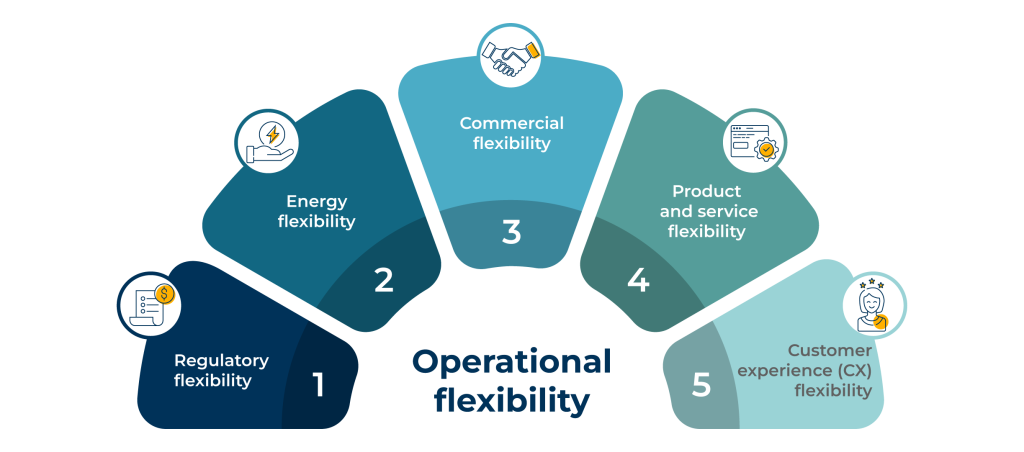
Regulatory flexibility
Allows assimilating regulatory reforms, rate schemes, and reporting requirements through configurable business rules and simple parameterization, without resorting to complex developments. This capability facilitates a more agile response to regulatory changes, eliminates the risk of sanctions, and allows the utility to keep its operation aligned with new provisions.
Energy flexibility
A unified platform must guarantee the utility the ability to support the operational complexity of the grid in real time, processing bidirectional energy flows, battery storage, charging infrastructure for electric vehicles, and demand response programs. With this agility, the company evolves toward an integrated provider model that diversifies its revenues and strengthens its presence in the market.
Commercial flexibility
Allows quickly configuring and launching rates, dynamic time-of-day pricing schemes, and attractive strategic alliances. This capability turns pricing policy into a competitive tool to respond precisely to the consumption patterns of each new customer segment.
Product and service flexibility
Facilitates expanding the offering beyond the traditional distribution of energy or public services, incorporating value solutions such as subscriptions, insurance, or services for homes and industries. By strengthening the company’s ability to package products and services without resorting to development, the utility significantly reduces its launch times and responds opportunely to market demands.
Customer experience (CX) flexibility
Offering personalized interactions, real self-management, and digital channels that respond to what the customer expects today, not to what was expected ten years ago. When that capability is lacking, it becomes impossible to build customer loyalty, and each failed or delayed procedure directly erodes credibility and trust in the public utility company.
The path toward operational flexibility
Utilities that continue treating each regulatory change, each new rate, or each customer demand as an exception that is solved with a patch will continue losing ground to those who designed their operation for constant change from the beginning.
By unifying the operation on an agile model, the company not only reduces the launch time of new products and services but also builds the real operational flexibility that allows it to anticipate the market instead of reacting late to it. In the new era of public services, this adaptability is what ultimately separates the companies that lead the industry from those left behind.
At Open Intelligence, we accompany the region’s utilities on this path, helping them integrate their entire commercial cycle on Smartflex, our unified platform designed to support the processes of energy, commercialization, regulation, operation, and customer service.
Is your organization ready to take the next step and respond on time to the next big market change?
References
[1] Gartner 2025. Market Guide for Utility Customer Information Systems.
[2] PwC. Global Compliance Survey 2025.