
In the utility industry, technological fragmentation often grows silently until it becomes a cost that is impossible to ignore. Disconnected systems, scattered data, and isolated processes generate hidden costs that directly impact efficiency, customer experience, innovation, and regulatory compliance. Faced with this challenge, our clients have eliminated the fragmentation tax with Smartflex. Today, they operate with a unified platform where processes, data, channels, and artificial intelligence work from a single source of truth to remove silos and move toward smarter, more profitable, and scalable management.
The silent enemy of profitability
In many utilities, operations rely on multiple specialized systems designed to solve specific needs. However, when these systems do not communicate seamlessly, disconnections, rework, and hidden costs begin to emerge, affecting overall business efficiency.
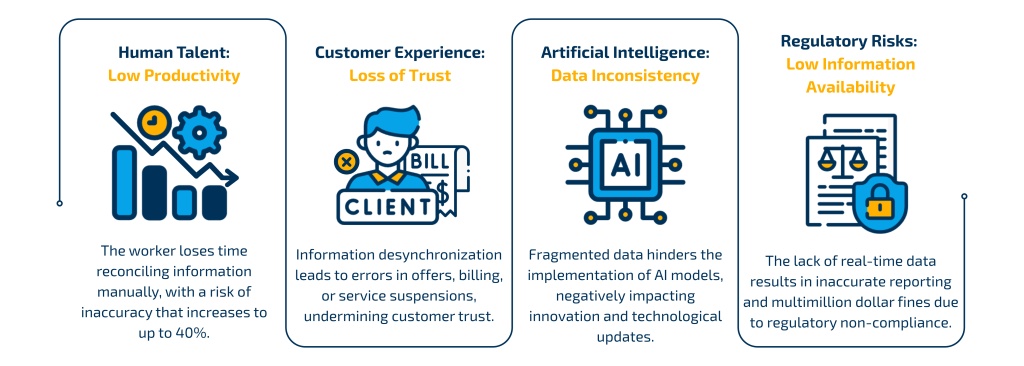
According to IDC research, utilities spend between 20% and 30% of their annual costs on inefficiencies directly caused by the lack of integration. This drain results from disconnected processes that affect productivity, customer experience, innovation, and regulatory compliance. Together, these hidden costs make up what is known as the fragmentation tax.
This tax usually becomes visible across four operational fronts:
Smartflex: the platform that unifies operations
To overcome this tax, companies need a new operating model. Trying to solve the problem by adding more tools to an already disconnected equation only makes the outcome worse.
It is like an old house with poorly located outlets, overloaded circuits, and rooms without enough electrical capacity. Instead of rewiring the house from the ground up, it gets filled with power strips, extension cords, and adapters. Everything appears to work until the system collapses. Each new extension seems like a practical solution, but it also adds risk, dependency, and complexity. The real problem is not the “lack of visible connections”, but an infrastructure that was never designed to handle the actual load.
Smartflex is the ideal solution. Designed specifically for the utility industry, this platform serves as a comprehensive ecosystem that manages the entire commercial and operational cycle from end to end. By unifying customer operations, Smartflex seamlessly integrates metering, billing, collections, customer service, and field operations, ensuring every department relies on the same real-time data.
As a result, utilities stop operating with isolated systems and start working with a single source of truth. Technology is no longer a limitation; it becomes an enabler of efficiency, innovation, and growth.
The Smartflex pillars for an intelligent operation
To turn a fragmented operation into an intelligent one, Smartflex provides a set of tools and engines that unify information, automate processes, and improve decision-making processes:
End-to-End customer operations management: Smartflex integrates the entire commercial and operational cycle into a single environment, from meter reading to billing, collection, field work, and customer service and experience. This end-to-end capability eliminates the need to purchase isolated solutions for each area and reduces the dependency on complex and fragile integrations.
Implementing this model has allowed one of our clients, Ecogas, to reduce its isolated systems infrastructure by 83%, achieving a consolidation of up to 18 independent platforms into only three core systems. With this, the company gained greater control, traceability, and operational efficiency.
Single database: Smartflex eliminates information silos and consolidates a single source of truth of customer operations. By centralizing information, teams can access consistent and up-to-date data without relying on manual cross-checks between systems, reducing the high risk of inaccuracies. By leveraging Smartflex’s unified 360° vision and management, our customers have reduced the average response time to customer requests by 87%, eliminating bottlenecks across the operation. At the same time, centralized information improves and accelerates innovation for artificial intelligence initiatives, since models no longer need to search, clean, or synchronize scattered data across different systems.
Regulatory compliance: The key to scalable operation is ensuring that information remains consistent across all processes and business areas, avoiding discrepancies between departments. Under this model, dashboards and reports centralize key data for decision-making, making audits easier, improving regulatory tracking, and reducing the need to extract information from external tools.
Self-service portal: By connecting natively to the platform’s core operations, our self-service portal eliminates fragmented customer experiences. Consistent, real-time data across all channels build trust and significantly reduces costly call center volumes. When the portal is an integral part of the platform and operates in real time, every interaction is reflected immediately. This prevents critical situations, such as unjustified service suspensions caused by payments not reflected in the system.
This native portal integration has enabled our customers to achieve digital adoption rates of 49% during the first year of deployment, while also reducing contact center calls by 32%. This agility strengthens customer satisfaction, delivering a fluid and reliable service experience free from the friction caused by disconnected systems.
AI agent engine (Alexandria): Alexandria brings artificial intelligence into the operation without creating new technological silos. Unlike external AI tools that operate as disconnected layers, Alexandria is embedded directly into Smartflex’s operational processes.
This allows it to analyze information and execute tasks within the platform, such as consulting data, updating records, initiating requests, or supporting customer service processes. As a result, end-user analysis times can be reduced by approximately 30%.
Flexible, adaptive, and autonomous operations: Smartflex includes multiple business rules engines that allow the platform to adapt to regulatory, commercial, or market changes without relying on complex developments. This has made it possible to implement new billing rules and rates in record time, within 24 to 48 hours, in response to emergency regulations.
Thanks to its No-Code and Low-Code capabilities, business teams can configure rules, parameters, and operational adjustments with greater autonomy. This reduces dependency on third parties and prevents the creation of technical patches.
Smartflex: the answer to the fragmentation tax
Choosing Open’s flagship platform, Smartflex, goes beyond simply acquiring new software. It is a strategic response to the costly fragmentation that undermines productivity, customer experience, innovation, and regulatory compliance.
In a market where inefficiency weakens financial sustainability and erodes public trust, having the support of a strategic partner that understands the complexity of utilities becomes a major competitive advantage.
Smartflex is the most robust and flexible option for companies seeking to unify their operations and move toward smarter, more profitable management.
Faced with the growing cost of maintaining disconnected systems, how much longer will utilities continue paying the fragmentation tax?