
Open Intelligence named a Major Player in the 2026 IDC MarketScape

CSWEEK.png
Transform complexity into simplicity!
Gartner® Market Guide for Utility CIS 2025

Can AI boost collections? Real-life case

Artificial intelligence is rapidly proving its value as a driver of financial health in the utility sector. Beyond automation, AI enables smarter, data-driven decisions that directly impact profitability.

One powerful example lies in the collections process: by analyzing usage and payment behavior, AI can identify high-risk accounts and guide targeted recovery efforts. As the number of service disconnections increases, along with the strain on field crews, AI-powered automation offers a way to maximize recovery while minimizing operational burden and cost.

One of our customers successfully overhauled its collection strategy using AI and automation. They shifted from a premises-based to a customer-based segmentation model to better prioritize accounts with high-value debts. The company automated key activities like debt analysis, work order creation, and closure. By integrating billing, payments, and field service, they enabled real-time cancellation of shut-off orders as soon as a payment was received, eliminating unnecessary site visits and improving resource deployment.

The results were substantial: 100% of the manual effort for collection analysis and assignment was eliminated, while the effort to assign or cancel work orders dropped by 66%. Unassigned shut-off orders fell from 53% to 22%, and the company saved up to $1 million in 2024 by avoiding unnecessary disconnection activity.

AI is not just a tool for efficiency; it’s a strategic lever for cost reduction, revenue protection, and smarter operations.
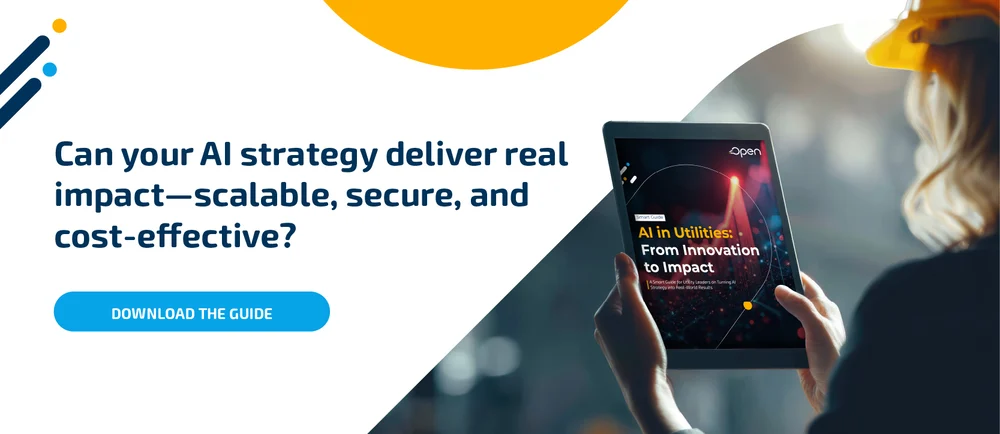
Go beyond the success story. You've seen AI's power in action, but implementing technology without a robust strategy can lead to significant setbacks. Ensure your AI investments pay off.

Share:

The Unified Customer Operations Platform

Smartflex is a unified customer operations platform for energy, water, gas, and telecommunications providers. It connects customer information, billing, self-service, meter data, and field operations in one platform, helping utilities simplify complexity, improve efficiency, and deliver better customer experiences. With embedded AI and native integration, Smartflex enables smarter operations, faster service, and long-term business agility.

Related posts

In the utility industry, technological fragmentation often grows silently until it becomes a cost that is impossible to ignore. Disconnected systems, scattered data, and isolated processes generate hidden costs that directly impact efficiency, customer experience, innovation, and regulatory compliance. Faced with this challenge, our clients have eliminated the fragmentation tax with Smartflex. Today, they operate with a unified platform where processes, data, channels, and artificial intelligence work from a single source of truth to remove silos and move toward smarter, more profitable, and scalable management.
Utility companies are facing the challenge of modernizing their infrastructure and customer-facing operations. Historically, these companies have grown by acquiring isolated tools to solve specific problems, resulting in fragmented architecture. This disconnect goes beyond technical issues to become a strategic obstacle. When information is trapped in disconnected systems, the ability to make real-time, data-driven decisions is lost, creating a gap that undermines the company’s competitiveness in an increasingly digital environment.
In the utility sector, customer experience (CX) has become a primary competitive differentiator. However, a critical disconnect exists between customers who demand seamless interactions and utilities operating under systems that fail to keep pace. This expectation gap is not merely a service challenge; it is an operational red flag.