

Customer Self-Service (CSS) portals have become critical for utilities’ efforts to deliver an outstanding Customer Experience (CX). However, these companies must consider holistic offers of CSS and CIS that allow them to enhance customers’ ability to perform self-management tasks, create connected experiences with end-to-end journeys, and reduce the efforts required to maintain complex system integration.

Today’s customers expect their utility to provide them with digital tools to access information and several service situations that were handled formerly over burdensome traditional channels (e.g., a phone call to a service line). By implementing CSS portals, utilities can meet the need of customers who want to have complete control over their accounts and have access to information 24/7. As a rule of thumb, these companies should look for portals that allow the customer to perform both conventional and advanced actions, including but not limited to:
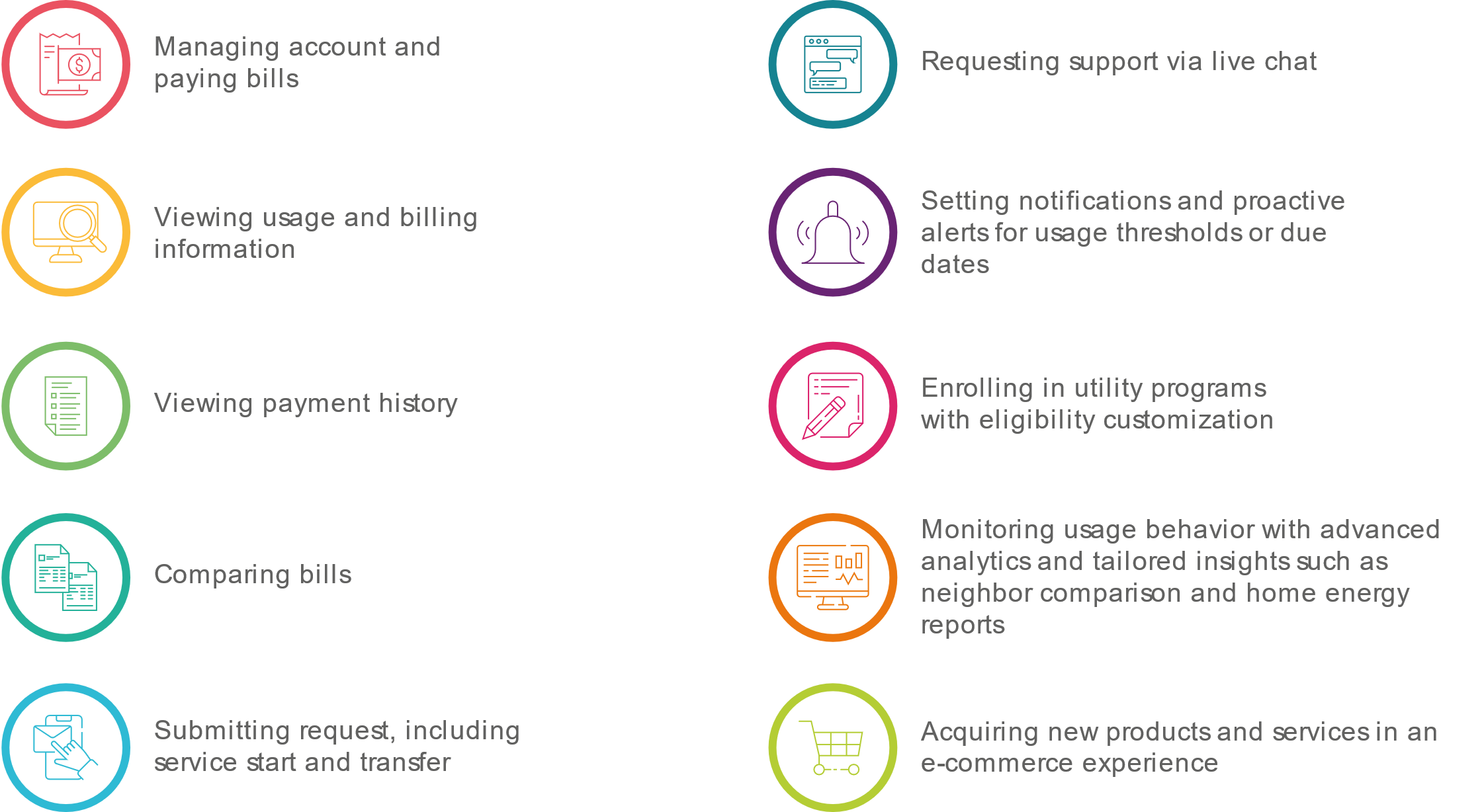
However, providing these features to customers on the quality of the data and the set of processes available on the CSS portal. With that in mind, utilities may be misled to implement a standardized, out-of-the-box CSS portal as a stand-alone solution, which requires integrations with back-office systems at the risk of creating a fragmented CX, duplicating data, and increasing the Total Cost of Ownership (TCO). Instead, their best option is to look for a self-service portal conceived as an integral part of a holistic solution to extend the capabilities of the CIS, working seamlessly to create end-to-end customer journeys.
By supporting their customer operations with a holistic CSS + CIS, both utilities and their customers can obtain many benefits. Having a common system architecture and a single database prevent data redundancy and maintain information synchronized and consistent across applications. This enables both systems, guaranteeing that any change is reflected in real-time in the CSS and the CIS.
Furthermore, a solution that speaks the same language throughout every process allows utilities to manage an omnichannel strategy that enables them to keep the context of every interaction with their customers regardless of the touchpoint in which they occur. Therefore, a customer who began an interaction on the portal (such as requesting a service transfer) may call the helpline or visit a service center to ask for the status of the request. In this case, all the information related to the process would be available on every channel.
According to McKinsey’s e-care survey, “60% of customers were less than fully satisfied with the channels available for contacting the utility, and almost 45% would prefer to use digital channels as their primary means of interacting with it […]”[1]
Having a 360° view of the customer also has a profound effect on CSR productivity and improves the first-time contact resolution ratio. From the customer’s side, a heightened perception of efficiency and quality in service is instilled, increasing overall satisfaction. Additionally, call-center productivity increases and costs are reduced, as a CSS portal that works in tandem with a CIS decreases incoming call volume, which in turn relieves CSRs from handling time-consuming service interactions. This allows them to perform other high-value activities such as promoting new products, services, and utility programs.
Giving customers total control over their utility accounts through a self-service portal empowers them to solve problems on their own while reducing pain points associated with service inquiries. To achieve this, utilities’ should be supported by a holistic solution that enables seamless CSS and CIS performance.
A well-rounded solution helps streamline the CX by creating enticing end-to-end digital journeys without the gaps produced by system integrations while also improving operational performance and reducing costs.
[1] McKinsey. (2018). The revival of customer loyalty: How regulated utilities can reshape customer engagement. https://www.mckinsey.com/industries/electric-power-and-natural-gas/our-insights/the-revival-of-customer-loyalty