
CSWEEK.png
Transform complexity into simplicity!
Gartner® Market Guide for Utility CIS 2025

Why do AI projects fail in utilities?

Throughout the adoption of artificial intelligence, utility companies face several challenges that must be addressed to achieve optimal results.
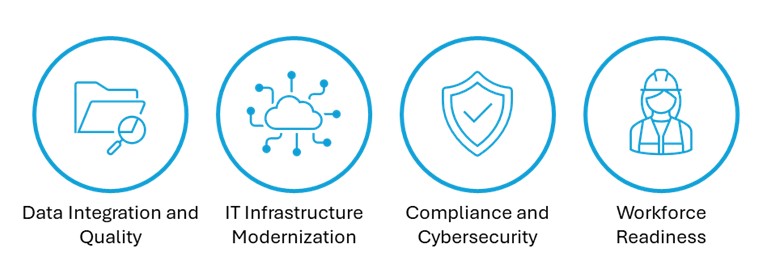
Many utilities operate with legacy systems that are not compatible with the advanced requirements of AI tools. Upgrading to a scalable, cloud-based, and modern infrastructure is crucial for supporting AI integrations, managing large datasets, and ensuring reliable performance. Moreover, due to the large volume of data processing, utilities need systems with a single database and repository to ensure cohesion.

Another major challenge is regulatory compliance and cybersecurity. As utilities adopt AI technologies that often involve sensitive information and automation, they must ensure that all processes comply with industry regulations, data privacy laws, and cybersecurity standards. Equally important is workforce readiness, where employees must be effectively trained to use new tools and understand the insights they generate.

AI succeeds when utilities align modern infrastructure with clear processes, secure data practices, and teams equipped to act on insights.


Discover the transformative vision of a fully integrated, AI-powered utility—efficient, intelligent, and ready for the future.

Share:

The All-in-one Utility CX & Billing Solution

Smartflex is a comprehensive platform for energy, water, gas, and non-traditional utilities, providing integrated solutions for customer information (CIS), self-service (CSS), meter data (MDM), and mobile workforce management (MWM). With native integration and embedded AI, it reduces costs, streamlines operations, and minimizes upgrade efforts. Smartflex accelerates digital transformation, fosters new business models, and enhances customer experience through its rule-based design and predefined workflows.

Related posts

Utilities are under pressure from every angle with tighter margins, stricter regulation, and competition, all while customers demand immediate resolution and seamless digital experiences. It’s no surprise that AI has become a strategic priority in almost every boardroom. However, a different reality often emerges: AI stuck in pilots, innovation labs, or isolated chatbots that never integrate into the core of day-to-day operations. Insights are generated, dashboards are built, but billing errors still occur, collections still linger, and field crews still respond to avoidable visits.
The energy sector is undergoing a deep transition, marked by changes that modify how energy is produced, distributed, and consumed. This creates challenges ranging from the decentralization of power grids to demand growth, which is driven by digitalization and artificial intelligence (AI). With this landscape in mind, a utility's adaptability no longer depends only on physical infrastructure but on the platform that supports all its business and customer management processes.
The energy sector is undergoing a period of accelerated evolution, marked by an adjustment in transition priorities and the increasing demand for renewable resources. This dynamic scenario presents both operational challenges and strategic opportunities for the most innovative utility companies. The key to navigating this environment lies in each company's agility, efficiency, and adaptability.