
Best CIS Implementation Award

CSWEEK.png
Transform complexity into simplicity!
Gartner® Market Guide for Utility CIS 2025

Why do AI projects fail in utilities?

Throughout the adoption of artificial intelligence, utility companies face several challenges that must be addressed to achieve optimal results.
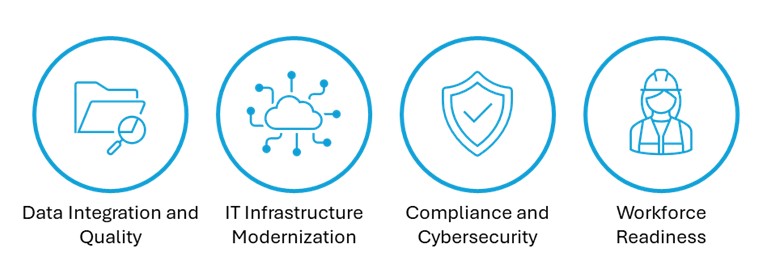
Many utilities operate with legacy systems that are not compatible with the advanced requirements of AI tools. Upgrading to a scalable, cloud-based, and modern infrastructure is crucial for supporting AI integrations, managing large datasets, and ensuring reliable performance. Moreover, due to the large volume of data processing, utilities need systems with a single database and repository to ensure cohesion.

Another major challenge is regulatory compliance and cybersecurity. As utilities adopt AI technologies that often involve sensitive information and automation, they must ensure that all processes comply with industry regulations, data privacy laws, and cybersecurity standards. Equally important is workforce readiness, where employees must be effectively trained to use new tools and understand the insights they generate.

AI succeeds when utilities align modern infrastructure with clear processes, secure data practices, and teams equipped to act on insights.
Discover the transformative vision of a fully integrated, AI-powered utility—efficient, intelligent, and ready for the future.

Share:

The Unified Customer Operations Platform

Smartflex is a unified customer operations platform for energy, water, gas, and telecommunications providers. It connects customer information, billing, self-service, meter data, and field operations in one platform, helping utilities simplify complexity, improve efficiency, and deliver better customer experiences. With embedded AI and native integration, Smartflex enables smarter operations, faster service, and long-term business agility.

Related posts

In the utility industry, technological fragmentation often grows silently until it becomes a cost that is impossible to ignore. Disconnected systems, scattered data, and isolated processes generate hidden costs that directly impact efficiency, customer experience, innovation, and regulatory compliance. Faced with this challenge, our clients have eliminated the fragmentation tax with Smartflex. Today, they operate with a unified platform where processes, data, channels, and artificial intelligence work from a single source of truth to remove silos and move toward smarter, more profitable, and scalable management.
Utility companies are facing the challenge of modernizing their infrastructure and customer-facing operations. Historically, these companies have grown by acquiring isolated tools to solve specific problems, resulting in fragmented architecture. This disconnect goes beyond technical issues to become a strategic obstacle. When information is trapped in disconnected systems, the ability to make real-time, data-driven decisions is lost, creating a gap that undermines the company’s competitiveness in an increasingly digital environment.
In the utility sector, customer experience (CX) has become a primary competitive differentiator. However, a critical disconnect exists between customers who demand seamless interactions and utilities operating under systems that fail to keep pace. This expectation gap is not merely a service challenge; it is an operational red flag.