
To effectively achieve their growth strategies, companies need to evolve and implement significant changes to their organizational structures, business processes, and IT infrastructure. Many companies see the multi-company model as the next step forward; however, this model cannot be successfully enacted without first putting the right IT systems in place.
To stay competitive in the modern environment, companies must constantly adapt their business practices to the social, technological, legal, political, and economic changes facing their’ industries. Furthermore, as globalization decreases barriers to market entry, companies are increasingly penetrating new markets and diversifying their product portfolio to maximize their viability on the international stage.
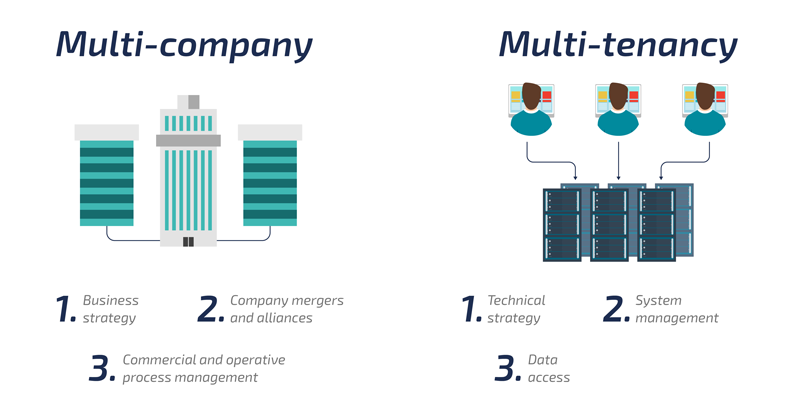
To achieve this level of internationalization, companies are including mergers and business alliances in their growth strategies; thereby mitigating risk and optimizing costs as they set the stage for the multi-company business model. In saying this, the term multi-company is commonly mistaken for multi-tenancy, which is a completely different concept.
Multi-company refers to how different companies associate with each other and the business processes through which they participate in a collaborative environment. This strategy can bring great business opportunities; however, it also presents considerable challenges such as defining common policies, making said policies easily adaptable to local market conditions, managing data access at different levels, and effectively satisfying regulatory reporting requirements on either a consolidated or per-company basis.
On the other hand, Multi-tenancy is a software-oriented term describing how a solution is managed. According to Gartner, this concept is “a reference to the mode of operation of software where multiple independent instances (tenants) of one or multiple applications operate in a shared environment(1).” In other words, it refers to a software solution which is implemented to serve multiple companies through a shared IT infrastructure.
Given the distinction between these two terms, it should be noted that a multi-tenant software solution is not necessarily required to support a utility company which is organized in a multi-company structure; in fact, many multi-company operations arising from business alliances or mergers are set up without multi-tenancy solutions.
When acquiring a software solution to support their operation, it is essential for decision-makers to know the difference between multi-company and multi-tenancy so that they can design an effective multi-company strategy which satisfies their’ unique functional and IT requirements.