
CSWEEK.png
Transform complexity into simplicity!
Gartner® Market Guide for Utility CIS 2025

Can AI boost collections? Real-life case

Artificial intelligence is rapidly proving its value as a driver of financial health in the utility sector. Beyond automation, AI enables smarter, data-driven decisions that directly impact profitability.

One powerful example lies in the collections process: by analyzing usage and payment behavior, AI can identify high-risk accounts and guide targeted recovery efforts. As the number of service disconnections increases, along with the strain on field crews, AI-powered automation offers a way to maximize recovery while minimizing operational burden and cost.

One of our customers successfully overhauled its collection strategy using AI and automation. They shifted from a premises-based to a customer-based segmentation model to better prioritize accounts with high-value debts. The company automated key activities like debt analysis, work order creation, and closure. By integrating billing, payments, and field service, they enabled real-time cancellation of shut-off orders as soon as a payment was received, eliminating unnecessary site visits and improving resource deployment.

The results were substantial: 100% of the manual effort for collection analysis and assignment was eliminated, while the effort to assign or cancel work orders dropped by 66%. Unassigned shut-off orders fell from 53% to 22%, and the company saved up to $1 million in 2024 by avoiding unnecessary disconnection activity.

AI is not just a tool for efficiency; it’s a strategic lever for cost reduction, revenue protection, and smarter operations.
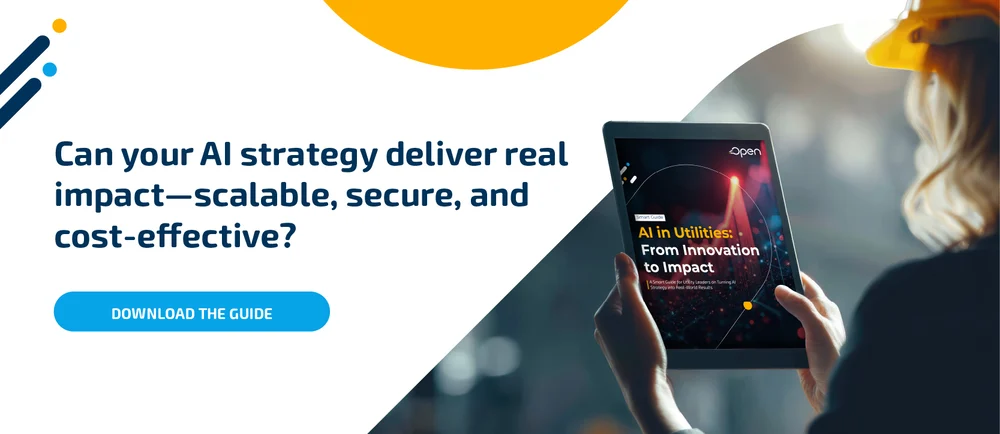

Go beyond the success story. You've seen AI's power in action, but implementing technology without a robust strategy can lead to significant setbacks. Ensure your AI investments pay off.

Share:

The All-in-one Utility CX & Billing Solution

Smartflex is a comprehensive platform for energy, water, gas, and non-traditional utilities, providing integrated solutions for customer information (CIS), self-service (CSS), meter data (MDM), and mobile workforce management (MWM). With native integration and embedded AI, it reduces costs, streamlines operations, and minimizes upgrade efforts. Smartflex accelerates digital transformation, fosters new business models, and enhances customer experience through its rule-based design and predefined workflows.

Related posts

Utilities are under pressure from every angle with tighter margins, stricter regulation, and competition, all while customers demand immediate resolution and seamless digital experiences. It’s no surprise that AI has become a strategic priority in almost every boardroom. However, a different reality often emerges: AI stuck in pilots, innovation labs, or isolated chatbots that never integrate into the core of day-to-day operations. Insights are generated, dashboards are built, but billing errors still occur, collections still linger, and field crews still respond to avoidable visits.
The energy sector is undergoing a deep transition, marked by changes that modify how energy is produced, distributed, and consumed. This creates challenges ranging from the decentralization of power grids to demand growth, which is driven by digitalization and artificial intelligence (AI). With this landscape in mind, a utility's adaptability no longer depends only on physical infrastructure but on the platform that supports all its business and customer management processes.
The energy sector is undergoing a period of accelerated evolution, marked by an adjustment in transition priorities and the increasing demand for renewable resources. This dynamic scenario presents both operational challenges and strategic opportunities for the most innovative utility companies. The key to navigating this environment lies in each company's agility, efficiency, and adaptability.