
Artificial intelligence is transforming an employee’s role in the utility industry, but it's true impact extends far beyond simple task automation. Its success lies in connecting processes, data, and technology to free teams from operational complexity. This empowers them to focus on oversight, decision-making, and driving greater value for customers and the business.
The reinvention of work in the utility sector
In many utility companies, resolving a seemingly simple request demands a monumental effort behind the desk. To investigate a potential billing error, an analyst must consult the Customer Information System (CIS), review metering data, verify payments, search for field orders, and reconstruct customer history by navigating through multiple disparate applications.
The root problem stems from the complexity required to complete these tasks. When the core systems managing utility operations lack native integration, employees end up bridging the technological gaps. This fragmentation severely hurts productivity and creates a constant cognitive load. Professionals must switch between interfaces, rebuild context for every case, and manually verify data accuracy. Consequently, interruptions, errors, and rework become permanent sources of operational friction.
In this landscape, platforms that unify the commercial lifecycle and embed artificial intelligence (AI) directly into value-generating processes offer the opportunity to radically transform how utilities operate. Their true value does not come from stacking isolated, contextless tools, but from natively integrating into operations to streamline workflows and boost organizational capabilities.
Employees as technology integrators
For years, utilities have introduced disparate systems to keep pace with new regulations and evolving market demands. The resulting environment is often a patchwork of legacy tools, fragile and complex integrations, spreadsheets, and manual processes. Although each tool serves a specific purpose, overall operations remain divided.
In practice, employees absorb the heavy cost of this disconnection. A large portion of their workday is consumed navigating internal complexity instead of solving real problems, optimizing processes, or making strategic business decisions.
Compounding this reality is the urgency to adopt emerging technologies. According to Gartner, 94% of technology leaders in energy and utilities planned to increase their AI investments for 2025. The research firm also projects that by 2027, 40% of companies in the sector will leverage AI-powered agents in their control centers. While this trend is undeniable, deploying innovation alone does not guarantee a better work environment [1].
Adding technology does not eliminate complexity
An isolated smart tool can speed up a specific task without improving the overall end-to-end process. If a customer service agent must leave their primary system, copy information, paste it into another platform, interpret the response without proper context, and navigate back to the original screen, the new technology simply becomes one more window to manage.
It may save time in one phase, but the Customer Service Representative (CSR) is still managing technological disconnection. Without immediate access to real-time, updated data regarding consumption, payments, and work orders, recommendations generated by these standalone models risk being incomplete.
Therefore, Return on Investment (ROI) should not be measured solely in the seconds saved when generating a summary. It must be evaluated holistically by looking at how many manual steps were eliminated, how many platforms were removed from daily consultation, and how much rework was avoided. True innovation drives profitability when it simplifies the ecosystem, not when it merely shifts the operational burden from one team to another.
The foundation of a unified platform
For these capabilities to yield tangible productivity gains, they must operate within the single environment where data originates, business rules are applied, and decisions are executed. Achieving this level of integration requires moving beyond layering modern tools on top of legacy processes.
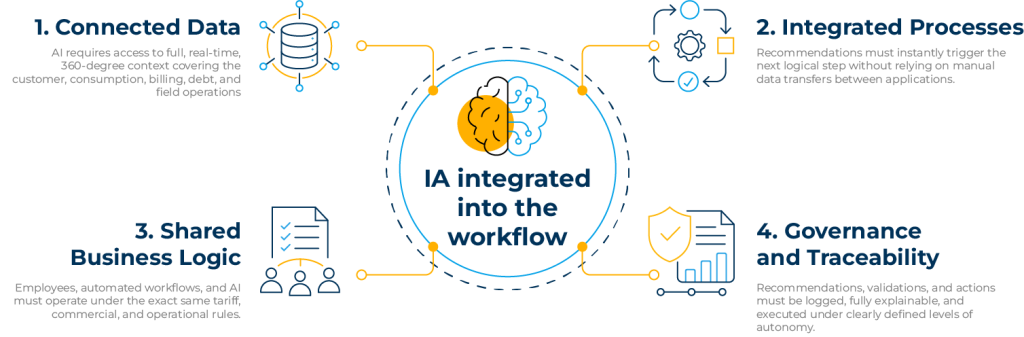
McKinsey warns that deploying innovations on top of traditional operating models yields only marginal improvements, whereas true value emerges when redesigning the very nature of work. In the utility sector,this means weaving advanced analytics, artificial intelligence, and core processes, allowing technology to act organically under human supervision [2].
From task executors to strategic orchestrators
The evolution of work is not about replacing human employees for robots. Its goal is to redesign how responsibilities are distributed between people and technology.
Advanced AI models can process massive volumes of information, identify underlying patterns, and recommend optimal actions based on consistent criteria. At the same time, humans contribute specialized industry expertise, critical judgment, empathy, risk assessment, and adaptability in handling unexpected situations.
In this new operating model, professionals evolve their day-to-day functions. They move away from piecing together fragmented information to receiving consolidated context out of the box. Instead of manually auditing every case, they focus exclusively on managing high-priority exceptions. They transition from executing routine manual steps to supervising automated workflows, validating analytical recommendations rather than applying manual rules, and shifting from reacting to everyday issues to anticipating strategic risks. This approach frees teams from repetitive tasks and redirects their potential toward high-impact business initiatives
Real operational impact across utility domains
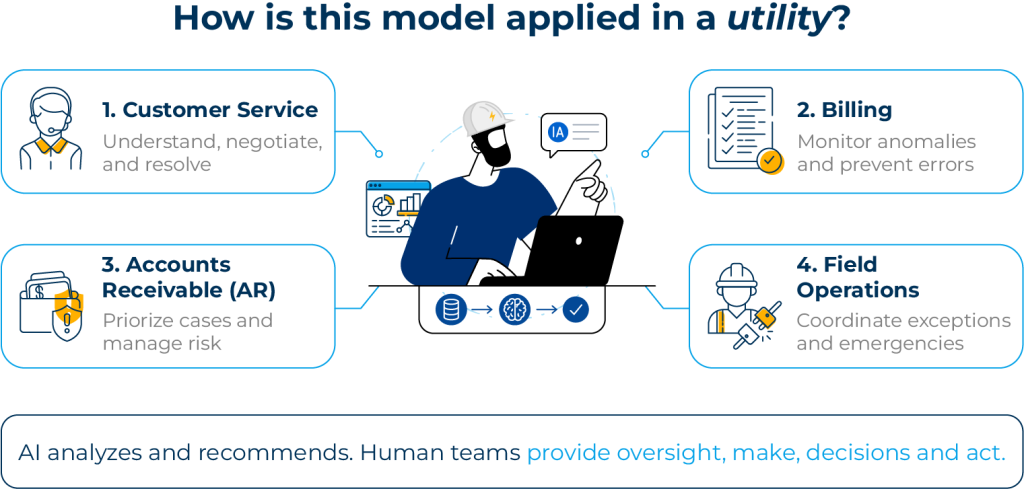
- In Customer Care: The unified platform consolidates interaction history, identifies the root cause of a complaint, and recommends the next best action. Representatives stop spending time investigating cases and instead focus their efforts on empathy, negotiation, and timely resolution.
- In Billing: Analysts move from auditing hundreds of records to leading a process that continuously evaluates the entire data universe and prioritizes critical anomalies. The system surfaces evidence of atypical consumption, enabling specialists to determine corrective actions and adjust business controls to prevent future recurrence.
- In Revenue Recovery & Collections: Debt is correlated with payment behavior, debt age, and historical payment agreements. Teams takes advantage of this context to anticipate recovery strategies that group clients in similar conditions, without depending on individual account-by-account audits.
- In Field Operations: The system recommends optimal work assignments considering task priority, location, and technical skill sets. Coordinators validate these recommendations and apply their expertise to resolve complex field emergencies.
Real productivity gains come from analyzing more data with greater accuracy, tilting the balance toward activities where human intervention is truly irreplaceable.
Less operational fatigue, greater strategic focus
No single technology can eliminate workplace burnout overnight. However, a unified operating environment mitigates critical frustration of drivers, such as system hopping across dozens of interfaces, duplicate data entry, and manual lookups. The goal for executive leadership is not to demand that talent process more data in less time, but to eliminate low-value tasks and provide complete clarity on business priorities.
This is where a unified platform marks a major turning point. Smartflex connects commercial and operational processes on top of a single database, seamlessly integrating customer management, metering, billing, collections, and field operations. By embedding intelligent capabilities directly into these workflows, it transforms raw data into actionable recommendations, and automatically recommendations into traceable actions, all within a single, connected ecosystem.
This approach allows software to handle automation and prioritization while leaders focus on validating insights and driving strategic decisions. The future of utilities will not be defined by the volume of tasks delegated to machines, but by leadership’s ability to fuse technology and human genius into one unified team. True digital transformation begins when innovation stops being an add-on tool and becomes the natural engine driving the business.
References
[3] https://www.mckinsey.com/mgi/our-research/the-real-ai-advantage