
The promise of Artificial Intelligence in the utilities sector is extraordinary: enhanced customer experiences, optimized field operations, and intelligent billing at scale. Yet a striking paradox defines the current moment. AI adoption is nearly universal, but meaningful ROI remains rare. The root causes of this gap are not technological. They are architectural. Two structural barriers: fragmented data and AI deployed as an external layer on top of legacy workflows. Understanding and addressing these two barriers is the prerequisite for any utility wanting sustainable AI-driven transformation.
Few technologies have generated more executive attention than Artificial Intelligence in enterprise operations. The macroeconomic case for AI is unambiguous:
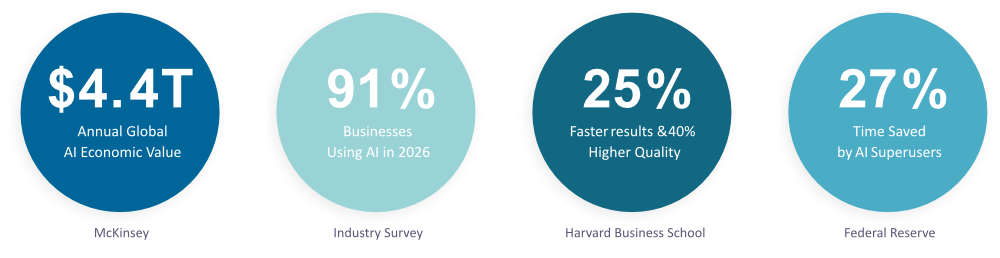
And yet, when the lens shifts from macro-promise to enterprise reality, a starkly different picture emerges.
According to MIT research, 95% of enterprise AI projects deliver zero measurable ROI, against an estimated $40 billion invested in AI initiatives in 2024 alone. Fewer than 1% of executives report achieving significant ROI from their AI investments, according to Forbes 2025. More than 80% of firms report no measurable bottom-line impact, despite near-universal adoption. Only 5% of integrated AI pilots ever cross the one-million-dollar ROI threshold.
For utility executives, these numbers deserve more than a passing glance. They raise a critical strategic question: if AI is this powerful, why are so few organizations capturing its value? The answer, it turns out, has little to do with the models themselves. It has everything to do with two structural conditions that determine whether AI can actually function inside a utility’s operational reality.
The First Barrier: It’s a Strategic One
Ask any utility CTO where AI breaks down in practice, and the answer frequently comes back to data. Not a lack of data, utilities are among the most data-rich organizations in any sector, generating continuous streams from smart meters, billing engines, customer service interactions, field operations, and network infrastructure. The challenge is that this data lives in disconnected compartments.
A typical mid-to-large utility may run a legacy billing and customer care system (CIS) that holds billing history and rate structures, a separate CRM for customer interactions, a standalone Meter Data Management (MDM) system tracking consumption intervals, and a Mobile Workforce Management (MWM) platform managing field dispatch, each with its own data model, update cadence, and integration logic. On paper, these systems appear to be “connected.” In practice, they create a fragmented operational reality.
When AI is introduced into this environment, it inherits its fragmentation. A model that cannot access the full customer and operational record cannot reason about it with any depth. The result is AI that generates insights no one acts on, because the gap between the insight and the workflow is too wide to bridge automatically. Faced with the cost and effort to close that gap automatically, most utilities fall back on manual processes. The path forward requires something more structural than better integrations. It requires a unified data foundation. When customer, metering, billing, and field data operate from a single data model, AI gains access to the full context needed to reason, prioritize, and act.
The Second Barrier: AI on the Side Is Not AI in the Business
Even where data quality and connectivity are addressed, a second barrier persists. It concerns not what data AI can access, but where AI actually lives in relation to the workflows it is meant to improve.
The dominant pattern in enterprise AI deployment today is what might be called “AI on the Side”. A chatbot interface layered on top of existing systems, a recommendation engine accessible via a separate portal, and a generative assistant available in a different browser tab. In this model, AI generates output and a human must manually translate that output into action within the systems where work actually happens. Copy, switch context, interpret, re-enter. The cognitive and operational overhead is significant, and it compounds with every interaction. There is no memory across sessions, no access to business rules, no ability to initiate transactions. AI becomes an advanced search tool rather than an operational participant.
The contrast with a genuinely embedded AI architecture is categorical rather than incremental. When AI is native to the application, with full access to the customer record, billing logic, service order workflows, and regulatory business rules, it does not merely suggest. It plans, reasons, and executes, with human oversight built into the process. An embedded AI agent handling a customer inquiry about a disputed bill can simultaneously verify consumption data against metering records, validate the applicable rate structure, assess payment history, and initiate a resolution workflow, without the customer service representative toggling between three systems to reconstruct the picture manually.
This is the distinction between AI as an external consultant and AI as an operational capability. The former adds information. The latter transforms throughput.
From Awareness to Action: Structural Readiness as the New Competitive Differentiator
What these two barriers share is that neither can be resolved at the margins. A new AI tool layered on top of a fragmented legacy stack does not solve the fragmentation problem. And an AI engine operating as an add-on won’t produce the throughput of one that is architecturally embedded in the workflow. The investments that fail to generate ROI, the 95%, are often not failing because the models are inadequate. They are failing because the underlying operational architecture is not ready to receive them.
This has an important implication for how utility executives should think about AI strategy. The relevant questions are not primarily “which AI vendor?” or “which use case first?” The prior questions are structural: Does our operational platform give AI systems access to unified, real-time data? And is AI embedded within the workflows where decisions are made and actions are taken or does it live outside them?
This is where Open positions itself as the ideal strategic partner. Through Smartflex, its unified customer operations platform built specifically for the utility industry, organizations gain the ability to integrate the entire commercial and operational cycle from end to end. By consolidating customer management, metering, billing, and collections into a single platform with a shared data model, Smartflex eliminates fragmentation at its root; not by building better bridges between silos, but by removing the silos altogether.
That comprehensive consolidation is also what makes truly embedded AI possible. Smartflex brings artificial intelligence into utility operations through Alexandria, its native AI engine, without creating new technological silos in the process. Alexandria is embedded directly within Smartflex’s operational processes. This means it can analyze information and execute tasks inside the platform itself like consulting data, updating records, initiating service requests, and supporting customer service workflows in real time. The result is not AI that advises from the outside, but AI that operates from within, where the data is complete, the business rules are enforced, and every action taken is grounded in the full operational context.
The question for utility leadership in 2026 is not whether to invest in AI. That decision has already been made across the sector. The question is whether the platform on which that investment rests is built to deliver on its potential or whether it is designed, by accident of legacy, to limit it.
Sources:
- McKinsey & Company, “The Economic Potential of Generative AI: The Next Productivity Frontier”
- MIT NANDA, “The GenAI Divide: State of AI in Business 2025”.
- Highpeak’s State of AI 2026.
- Goldman Sachs’ 2026 Small Business Survey
- Harvard Business School, MIT Sloan, Wharton, and Boston Consulting Group
- Federal Reserve Bank of St. Louis, “The Rapid Adoption of Generative AI” and “The Impact of Generative AI on Work Productivity”