
CSWEEK.png
Transform complexity into simplicity!
Gartner® Market Guide for Utility CIS 2025

Reinventing billing for prosumers through net metering and net billing

The roles of energy market participants have changed due to the growing number of customers that both produce and consume energy. The rise of prosumers is continuing to disrupt traditional operating models and lead the utility industry into the future.

Every time an energy consumer installs their first energy-generation system, there is one more prosumer on the network; these customers are capable of partially covering their own consumption and using the power distribution network as a conduit to share excess power with other connected customers. To keep track of prosumers and the new ways in which they interact with the grid, it is critical to accurately calculate the difference between production and consumption in real-time and use this information to inform billing processes.
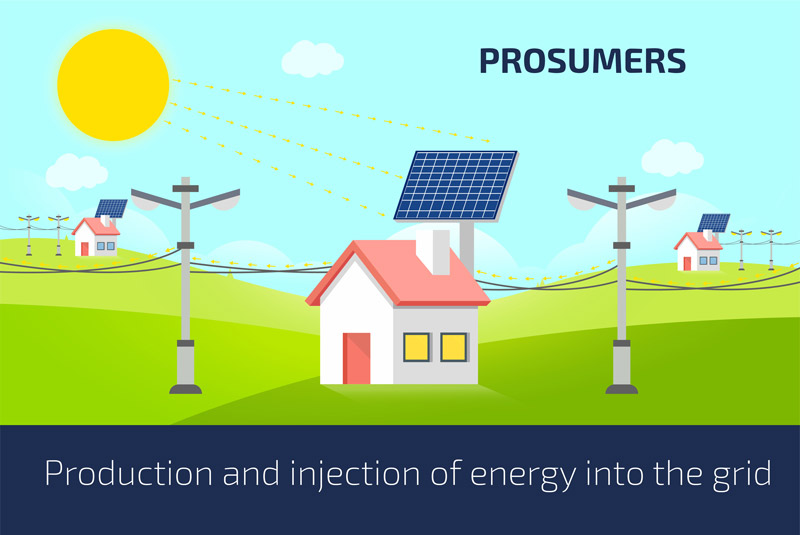
According to the Solar Energy Industries Association (SEIA), only 20-40% of a solar energy system’s output ever goes into the grid and solar customers usually consume more energy than they export each billing cycle1.

Utilities rely on two different billing models to compensate prosumers’ production and bill their net energy usage.

Net BillingNet Metering
  • Both consumption and generation are recorded and billed separately. As a result, customers get charged their full retail rate per kWh when they use energy from the grid, but they are also compensated with the same rate for energy exported to the grid.
  • Customers get charged based on their net usage of kWh at the end of each billing cycle.
  • Periodically, the utility calculates and informs the charges related to net usages.
  • Any excess electricity generated can be credited to the customer for future consumption, just like rollover minutes on a phone plan.
  • The utility bills a minimum charge each billing cycle. At the end of the year, the utility bills the charges related to net usage.
  • Every month the utility bills a minimum charge and the usage charge (if net usage is positive)
For both Net Billing and Net Metering, utilities carry out a true-up process at the end of each yearly cycle. This process involves crediting or debiting customer accounts to correct for any energy which was not accounted for by monthly billing and after it is completed, all outstanding debt between utility and customer will be cleared.

Choosing the right model depends on the regulations and specific needs of each utility. In the US, 43 states and D.C. have already implemented net metering policies; however, these policies vary significantly by state2.

Of the 116.9 million residential buildings in the U.S., there are 67.2 million buildings (57% of the total) suitable for solar PV.

Forbes3

Prosumers are no longer on the horizon, they have become a powerful force in the modern energy market and many utilities are already working with them to encourage the transition into a more collaborative energy economy.
To find out about the strategic tools needed to succeed in this new market, read the next article:

(1) https://www.seia.org/initiatives/net-metering

(2) https://www.seia.org/research-resources/net-metering-state

(3) https://www.forbes.com/sites/rrapier/2018/04/29/the-solar-power-potential-of-rooftops-in-the-u-s/#7687bf395109

Share:

The All-in-one Utility CX & Billing Solution

Smartflex is a comprehensive platform for energy, water, gas, and non-traditional utilities, providing integrated solutions for customer information (CIS), self-service (CSS), meter data (MDM), and mobile workforce management (MWM). With native integration and embedded AI, it reduces costs, streamlines operations, and minimizes upgrade efforts. Smartflex accelerates digital transformation, fosters new business models, and enhances customer experience through its rule-based design and predefined workflows.

Related posts

In the utility sector, customer experience (CX) has become a primary competitive differentiator. However, a critical disconnect exists between customers who demand seamless interactions and utilities operating under systems that fail to keep pace. This expectation gap is not merely a service challenge; it is an operational red flag.
Have you ever stopped thinking that behind a billing error, there is much more than human failure? Often, it is a professional trapped in a technological labyrinth of disconnected data and tools. For years, the utilities sector has operated in an era of manual tasks, where talent is worn down trying to act as the bridge between disjointed systems. This cycle is broken through a unified platform designed to optimize operations, empower employees with technology, and transform processes into a competitive advantage, enhancing customer satisfaction.
Traditional debt management can be effective, but it often lacks empathy toward the reality of households. Today, the true challenge lies in transforming collections into an intelligent and human-centric process. To achieve this, utilities require a unified customer management platform that, by integrating critical data and processes with advanced technology, can deploy AI-powered proactive actions, segment vulnerable customers, flexibly create assistance programs, and enable a truly omnichannel collection ecosystem. Discover how to ensure the financial health of your operation while protecting the relationship with your customers.
